
Understanding Facial Asymmetry in Congenital and Developmental Cases
When a congenital or developmental skeletal discrepancy exists, the solution is rarely as simple as moving a single jaw. Patients often ask, “Can’t we just move one jaw?” In reality, true facial balance and long-term success depend on treating the face as a fully integrated skeletal system.
In our practice, we frequently see patients who have already undergone orthognathic (jaw) surgery—often bimaxillary surgery—to address functional problems such as malocclusion, airway compromise, or obstructive sleep apnea. These procedures are powerful and often life-changing. They reposition the jaws, improve breathing, restore bite function, and significantly enhance facial proportions.
Yet, even after technically successful jaw surgery, some patients still perceive residual asymmetry. This is not uncommon—and it is not a failure of surgery.
The reason is simple: jaw surgery corrects position, not always shape. In many congenital or developmental cases, asymmetry is embedded deeper in the skeletal framework, including:
- Variations in mandibular angle shape and width
- Asymmetric tapering of the jaw body
- Subtle cranial base rotation or tilt
- Differences in bone volume that developed over years of growth
Surgery can realign jaws in space, but it cannot fully rewrite the underlying skeletal history.
The Case: When Surgery Alone Wasn’t Enough
One of our recent patients presented after undergoing bimaxillary surgery. His functional concerns had been successfully resolved: his airway was improved, his bite was stable, and jaw positioning was correct. However, both the patient and his surgical team noticed that ideal facial symmetry remained just out of reach.
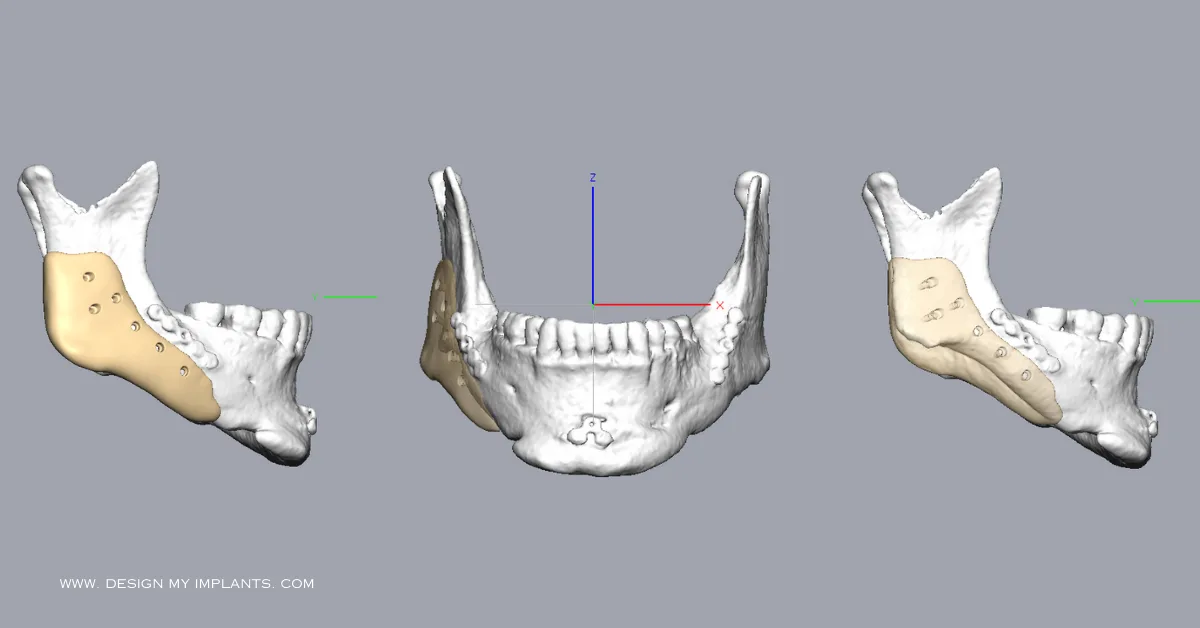
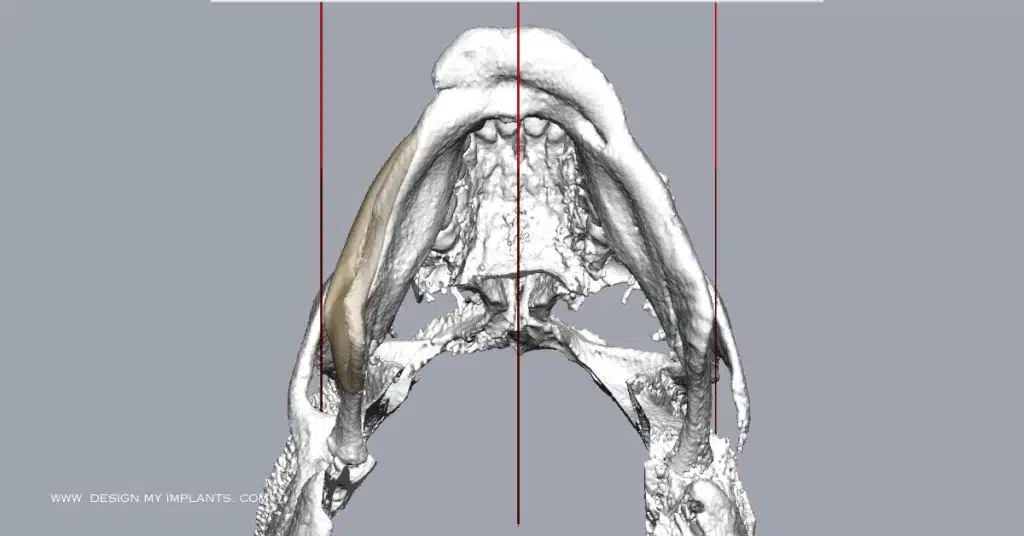
A detailed 3D skeletal analysis revealed the root cause. While the jaws were now properly positioned, the mandibular angles and lower facial skeleton remained asymmetric. One side exhibited a different taper and projection, and the cranial base demonstrated a subtle inward and downward rotation.
This was not an error—it was a limitation of what orthognathic surgery alone can address in complex developmental asymmetry. When asymmetry is woven into the skeleton over decades of growth, achieving balance often requires refinement beyond bone movement.
The Solution: Fully Custom Bioactive PEEK Jaw Angle Implants
To achieve true skeletal harmony, we turned to fully custom-designed jaw angle implants—specifically, Design My Implants (DMI) bioactive PEEK implants, which are fundamentally different from traditional PEEK implants.
Why Custom Matters
Standard, off-the-shelf implants are manufactured in fixed shapes and sizes. While they can add volume, they cannot precisely correct individualized asymmetry. In contrast, custom implants are designed directly from the patient’s 3D anatomy.
Using advanced imaging and digital planning, we designed implants that did not merely “fill space,” but instead mirrored the ideal contralateral anatomy. Every contour, angle, thickness, and transition was engineered to restore balance at the skeletal level.
The result was 100% skeletal symmetry at the mandibular angle level, creating perfectly mirrored jaw contours from left to right.
What Makes Design My Implants PEEK Different?
It is important to emphasize that these were not traditional PEEK implants.
Characteristics of Design My Implants Bioactive PEEK
The DMI implants are manufactured from bioactive PEEK that undergoes a specialized surface activation process. This treatment serves two critical biological functions:
1. Overcoming PEEK Bio-Inertness
Conventional PEEK is mechanically excellent but biologically inert. Without modification, it can become encapsulated by fibrous tissue.
DMI’s surface activation transforms PEEK from a passive material into a bioactive interface, significantly reducing the risk of:
- Fibrous encapsulation
- Implant mobility
- Chronic inflammation
- Long-term implant intolerance or rejection
2. Creating an Optimal Biological Interface
The activated surface is engineered to:
- Mimic the osseointegration principles of titanium dental implants
- Promote stable interaction with surrounding bone
- Encourage biological adhesion and sealing with soft tissue
This biological sealing is critical. It dramatically reduces the risk of:
- Wound dehiscence (incision breakdown)
- Seroma or fluid collection
- Peri-implant pocketing
- Late infection or implant exposure
The clinical objective is not simply structural support—it is long-term biological integration.
The Bigger Picture: Symmetry Is About Visual Harmony
Following implantation, all perceivable asymmetry in the jawline and lower facial third was eliminated. While a minimal cranial tilt still exists, it falls well below the threshold of visual perception in daily life.
The face now reads as balanced, natural, and harmonious.
This highlights a core principle we emphasize in facial skeletal design:
Symmetry is not about mathematical perfection—it is about what the human eye perceives as balanced.
By refining the areas that most strongly influence facial aesthetics—jaw angles, mandibular width, and contour transitions—we can create results that appear perfectly symmetrical, even when the underlying anatomy tells a more complex story.
Conclusion: Facial Balance Is Often a Two-Part Journey
For patients with congenital or developmental asymmetry, achieving optimal results often requires a staged approach:
- Functional and Proportional Correction
Orthognathic surgery to address bite, airway, and jaw position. - Aesthetic and Skeletal Refinement
Fully custom, bioactive PEEK implants to correct bone shape and contour that surgery alone cannot change.
If you have undergone jaw surgery and still feel your facial symmetry is not quite complete, you are not imagining it—and it is not uncorrectable.
With modern 3D planning, custom implant design, and biologically active materials like Design My Implants bioactive PEEK, we can now address facial asymmetry at its true skeletal source.
Because in the end, facial harmony isn’t just about moving bones.
It’s about designing balance—down to the last millimeter.
Interested in Learning More?
If you would like to explore custom facial implants or discuss your own journey toward facial symmetry, contact us to schedule a personalized 3D analysis and consultation.