
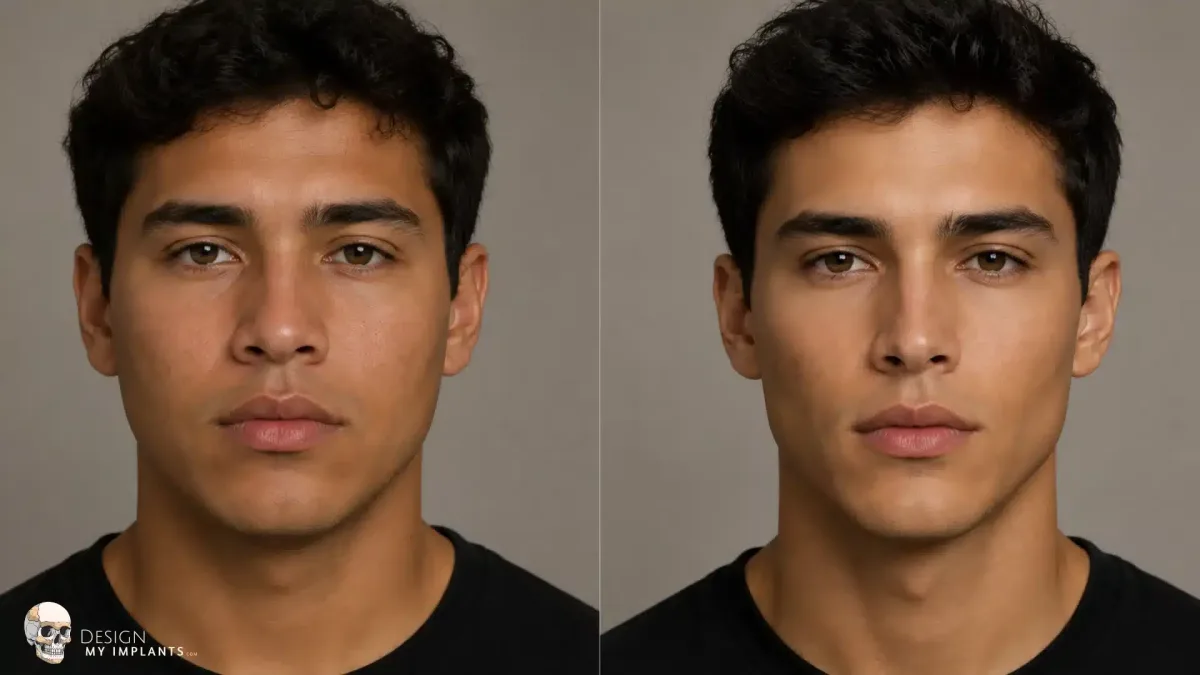
Custom facial implants can shift how a face reads structurally — stronger cheekbones, fuller midface volume, a broader jaw. What they can’t do is reassign your ethnicity outright.
When QOVES Studio posted a video asking what makes French men’s faces attractive, the comments turned into a geography lesson nobody asked for. One viewer swore the face was Italian. Another said Algerian. A third insisted it was Mediterranean, not French at all, and pointed out that northern France doesn’t look anything like the Riviera. Dozens of replies piled on arguing about jawlines, cheekbones, and coloring, and nobody landed on an agreement.
That disagreement says something worth unpacking: we associate certain facial features with certain ethnicities, even though those same features show up across populations constantly. So when patients ask whether facial implants can change how “ethnic” their face looks, the honest answer is more nuanced than a yes or no.
Why we read faces as "ethnic" in the first place
Humans are pattern-matchers. We take a handful of visual cues — a wider jaw angle, a prominent brow ridge, a certain cheekbone height or nasal bridge shape — and use them as shorthand for where someone “must” be from. That shorthand isn’t baseless; certain bone structure tendencies do appear more often in some populations than others. But tendencies aren’t rules.
The variation within any single country or ethnic group is often larger than the variation between groups. That’s exactly why a comment section full of people from different backgrounds looked at one face and confidently named five different nationalities. The face wasn’t ambiguous because it was unusual — it was ambiguous because the traits people read as “French,” “Italian,” or “Mediterranean” simply aren’t exclusive to any one of them.
What patients are actually asking for
In real consultations, this question splits roughly two ways. Some patients want to soften a feature they feel is too strongly tied to a stereotype they don’t identify with. Others admire a specific look and want to incorporate elements of it into their own face. Both are common, and neither is about rejecting or erasing identity.
Most of the time, what a patient is describing isn’t “I want to look like a different ethnicity” — it’s “I want this specific part of my face, my jaw, my chin, my cheekbones, to look a certain way.” That distinction matters, because it changes what a surgeon and design team are actually solving for.
What custom facial implants can — and can't — change
This is where the answer gets more specific than a flat yes or no. Custom chin, jaw, and cheek implants adjust structural elements: projection, width, angle, and symmetry. And some of those structural traits are genuinely associated, on average, with certain regions of the world.
Fuller cheekbone projection and added midface volume, for example, read as more associated with Latin American or Eastern European bone structure. A broader, more angular jaw is often read as a Northern European trait. Midface volume in particular is a common request from patients of East Asian descent, since Asian facial anatomy on average carries less natural projection through the cheeks and midface than some other populations — cheek and midface implants are built specifically to add that support.
So implants can move a face in a specific structural direction, and that direction can genuinely read as more associated with one region than another. What they can’t do is take over everything else that also signals ethnicity: skin tone, eye shape and spacing, hair texture, and the soft-tissue characteristics that come from genetics rather than bone. A patient can walk out with noticeably different cheek, jaw, or midface structure — but not a different ancestry. It’s a shift in degree on specific features, not a full reassignment.