
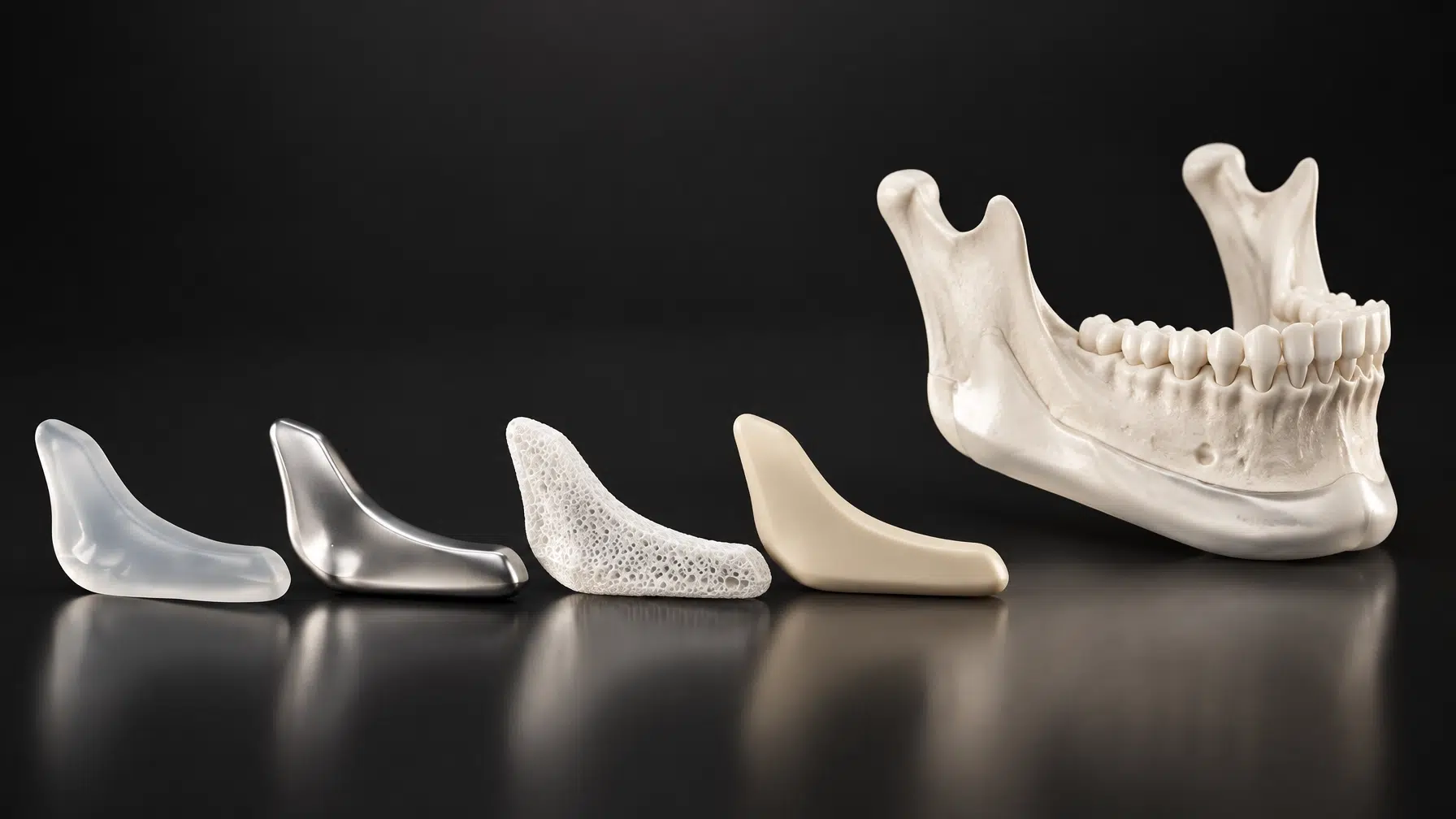
Illustrative rendering of the four implant material categories. Not an actual patient case.
If you’re researching custom jaw implants, you’ve probably encountered several material categories used in jawline augmentation, including silicone, titanium, porous polyethylene, and PEEK. You may also be comparing different implant providers, surgical approaches, and material philosophies.
That research matters. DMI’s position is not ambiguous. We design and engineer patient-specific implants in DMI Bioactive PEEK. We do not engineer silicone, titanium, or porous polyethylene implants. This describes DMI’s engineering and manufacturing scope; it is not a recommendation that DMI Bioactive PEEK is clinically appropriate for every patient.
The more useful question is:
Which material, design, and surgical plan are appropriate for your specific anatomy and goals?
Your face is a three-dimensional structure. Your chin, jawline, jaw angle, cheek, brow, and midface influence how you perceive one another. A material choice is important, but so are the implant’s shape, fit, fixation, surgical access, and relationship to the rest of your facial structure.
DMI is an engineering, implant design, manufacturing, and coordination partner. DMI is not the treating surgeon, does not provide medical care, and does not determine candidacy. Clinical decisions belong to your surgical team.
This guide compares those material categories, explains what the published literature reports about silicone and bone response, and shows why DMI’s design philosophy centers on a rigid, patient-specific implant.
What’s the difference between the implant materials?
Silicone: a long-established implant material
Solid silicone has long been used in facial implant procedures and is commonly described as a nonporous material that can be manufactured in a range of shapes and sizes. It is the material category most commonly discussed in the published literature in relation to bone response beneath facial implants. Silicone has a long history in facial augmentation, and it remains the material most frequently associated in the published literature with the bone-response considerations described below. DMI’s engineering scope is centered on rigid, patient-specific implants in DMI Bioactive PEEK. The design is developed around the available anatomical data and the objectives established with the treating surgical team. Which material is appropriate in any individual case remains a decision for your treating surgeon.
The material science is best explained by your surgical and engineering team in the context of your case.
What does the literature say about bone response beneath silicone implants?
Published literature describes bone resorption (also referred to as erosion) beneath silicone facial implants as a recognized consideration, particularly in the context of silicone chin augmentation.[^1][^2][^3][^4][^5] This is not described as something that happens in every case, and it should not be treated as a universal outcome. It is a reported risk and a design, stability, and follow-up consideration that your treating surgeon evaluates in the context of your anatomy and surgical plan.
In the literature, the leading proposed mechanisms involve sustained implant pressure over the underlying bone driving bone remodeling, with micromovement potentially amplifying that pressure effect.[^1][^2][^3][^5] Some authors discuss screw fixation as a way to limit mobility and potentially reduce resorption, although bone changes have also been reported in fixation-based cases.[^1][^3] Periosteal elevation and subperiosteal bone changes are also discussed as contributing factors in pressure-related erosion beneath chin implants.[^2][^3][^5]
Long-term radiology follow-up studies have reported measurable erosion beneath silicone chin implants, often on the order of up to about 2 mm, although the extent can vary by case, technique, implant position, and follow-up interval.[^2][^4] That is exactly why implant design, precise fit, stability, fixation, and surgical technique are not minor details. They are central planning decisions.
This is also where a patient-specific engineering approach matters. A rigid, patient-specific design involves different engineering considerations from a flexible material, including fit, fixation, and positioning. For DMI, those documented bone-response findings are precisely why our design philosophy is centered on a rigid, patient-specific implant engineered to fit the underlying bone, with fit, stability, fixation, and stability planning treated as engineering decisions rather than afterthoughts. Your treating surgeon is the person who evaluates how this literature applies to your specific case.
Published literature also reports that bone resorption or erosion after chin augmentation has been discussed in relation to more than one implant material. Systematic reviews describe mandibular bone resorption across the chin-implant literature, but the available evidence is heterogeneous and does not establish a simple material-by-material risk ranking.[^6][^7] These findings should be understood as reported observations and planning considerations rather than universal outcomes, and the treating surgeon is the person who evaluates how those risks apply in an individual case.
Titanium: a rigid metallic material
Titanium is a biocompatible, rigid, strong metal with a long history in craniofacial and maxillofacial reconstruction and fixation.[^7][^9] Titanium can be machined into implant forms and is generally radiopaque, so it is visible on X-ray and CT imaging. The extent and type of imaging artifact depend on the implant, imaging modality, and imaging protocol.[^8][^9]
Two trade-offs are described in the literature. First, titanium may produce imaging artifacts, including MRI signal effects and CT or CBCT streaking or beam-hardening artifacts. The practical significance depends on the implant and the imaging study.[^8] Second, bone resorption or erosion beneath chin implants has been reported following chin augmentation with a range of implant materials, including metallic and non-metallic implants.[^6][^7]
Titanium remains a well-established material in reconstruction and fixation. The trade-offs described in the literature relate to imaging behavior and to the broader bone-response considerations that apply across implant materials. Your treating surgeon and imaging team can explain how those issues may matter in your specific case.
Porous polyethylene (Medpor, Porex): a porous material
Porous polyethylene is a high-density polyethylene implant material with a porous surface structure.[^7][^9][^10] Its defining characteristic is a porous structure that can permit fibrovascular tissue ingrowth and tissue adherence, and that adherence may contribute to stability after placement.[^7][^9][^10]
That same property shapes its trade-offs. Because tissue becomes adherent to the implant, removal is generally described as more technically demanding than removal of a nonporous material such as solid silicone, and implant removal may require piecemeal removal with care to avoid injury to nearby nerves, blood vessels, and the overlying soft-tissue envelope.[^9][^10] Reported complications include infection and extrusion, which have been reported and may require additional treatment or removal, depending on the clinical circumstances.[^7][^9]
Porosity is a deliberate design characteristic that may influence tissue adherence and stability, while also affecting revision and removal considerations. That is a practical planning consideration for the patient and surgeon.
PEEK: a rigid engineering polymer
PEEK, or polyether ether ketone, is a high-performance polymer used in medical and craniofacial applications. PEEK is commonly described as lightweight, mechanically strong, and radiolucent — meaning it may appear differently on CT and MRI studies than some other materials. Your imaging and surgical team can explain how any implant material may appear on your studies.
PEEK can be digitally designed and manufactured around patient-specific anatomical data. Its rigidity may be useful when a design requires a stable, highly defined three-dimensional form.
However, conventional PEEK and DMI Bioactive PEEK should not be treated as identical.
PEEK is the material. Bioactive PEEK is DMI’s engineered approach to that material.
DMI’s Bioactive PEEK incorporates additional material and surface-engineering processes intended to advance conventional PEEK. The technology story is not simply that an implant is “made from PEEK.” It is how that material is engineered, designed, manufactured, and incorporated into a surgeon-led treatment plan.
PEEK was the starting point. Bioactive PEEK is where we took it further.

Illustrative rendering. Not an actual patient case.
What should determine your implant design?
DMI’s design process starts from your anatomy and the objectives established with your surgical team, and works within DMI Bioactive PEEK. The variables that shape a design include:
- Your bone structure
- Your soft-tissue thickness
- The areas being augmented
- The amount and direction of projection
- Whether asymmetry is part of the design
- The surgical access required
- Fixation and positioning
- Potential future revision
- Your surgeon’s experience and recommendation
A custom jaw angle implant may have different design priorities from a smaller chin implant or a full wraparound jawline implant.
This is why a material comparison should inform your consultation, not replace it.
Why does patient-specific design matter so much?
Traditional implant approaches often begin with a predefined shape selected from a catalog. That approach can be appropriate in some cases, particularly when a standard shape aligns well with the patient’s anatomy and surgical objectives.
DMI begins differently.
We start with your anatomy, your imaging, and the objectives established with your surgical team. From there, we engineer a patient-specific solution around the available information.
That difference can matter when your goals involve:
- Jawline width
- Jaw angle definition
- Ramus contour
- Chin-to-jaw transitions
- Facial asymmetry
- Uneven bone structure
- Multiple connected facial regions
- A specific three-dimensional contour
A custom design does not guarantee a particular aesthetic outcome. It does create a more individualized planning framework in which your anatomy is considered before manufacturing begins.
The material cannot compensate for a poorly conceived design. A sophisticated material still needs an appropriate shape, position, thickness, edge transition, and fixation strategy.
The individual should come before the implant.
How is a custom jawline implant designed?
1. Imaging creates the foundation
Patient-specific facial implant engineering begins with appropriate patient-specific data, commonly including CBCT imaging and DICOM files.
The quality of the design depends on the quality and suitability of the underlying data. Your surgical team and imaging provider determine what imaging is clinically appropriate. DMI uses the available information for three-dimensional analysis and engineering.
An incomplete, unsuitable, or poorly acquired scan can limit what can be designed accurately.
2. Your facial structure is mapped
The face is not a collection of isolated components. The chin influences the perceived jawline. The jaw angle relates to the lower face. The cheek, midface, and brow can affect how you perceive overall balance.
That does not mean every region needs to be treated. It means your implant design should be considered within the context of your facial proportions.

Illustrative rendering. Not an actual patient case.
3. The design is refined collaboratively
DMI translates patient-specific anatomy and surgical objectives into a three-dimensional engineering concept. The design may be refined through review and discussion.
Your role is to communicate what concerns you and what you hope to change. Your surgeon’s role is to determine clinical appropriateness, candidacy, surgical technique, and medical decisions. DMI’s role is engineering, implant design, manufacturing, and coordination.
DMI is not the treating surgeon.
4. The approved design moves toward manufacturing
Manufacturing should begin only after the appropriate review and approval process has been completed. The final implant design should reflect the surgical plan established by qualified professionals.
The purpose of this process is not to rush toward production. It is to create a clearer, more deliberate connection between your anatomy, your goals, the surgical plan, and the physical implant.
How do the implant materials compare?
| Consideration | Conventional silicone | Titanium | Porous polyethylene (Medpor/Porex) | DMI Bioactive PEEK |
|---|---|---|---|---|
| Material behavior | Long-established nonporous material used in facial augmentation; handling and flexibility depend on the implant design. | Rigid metallic material with high mechanical strength. | Porous material that can permit fibrovascular tissue ingrowth and tissue adherence. | Rigid engineering polymer used in patient-specific digital design and manufacturing. |
| Design approach | Available in standard and custom configurations | Can be machined into implant forms and used in craniofacial reconstruction | Available in preformed and custom implant applications depending on the case and provider | Designed around patient-specific anatomy through digital planning and manufacturing |
| Imaging | Your imaging and surgical team can explain how the material may appear on CT/MRI | Radiopaque and visible on X-ray/CT; the literature also describes MRI susceptibility artifact and CT/CBCT beam-hardening artifact | Your imaging and surgical team can explain how the material may appear on CT/MRI | Your imaging and surgical team can explain how the material may appear on CT/MRI |
| Stability / fixation | Stability and fixation depend on implant design, placement, and the surgical plan | Stability and fixation depend on the implant design, hardware strategy, and the surgical plan | Tissue adherence may contribute to stability after placement; fixation decisions remain case specific. | Stability and fixation depend on the design, fixation strategy, and the surgical plan |
| Revision considerations | Your surgeon can explain potential modification or removal options | Your surgeon can explain revision considerations, including hardware-related factors | Removal may be more technically demanding because tissue can become adherent to the implant. | Revision depends on the design, fixation, and the clinical situation; your surgeon can explain whether revision may be an option in your case. |
| Technology distinction | Conventional silicone material | Conventional titanium material | Conventional porous polyethylene material | DMI Bioactive PEEK includes additional material and surface-engineering processes |
This table is a starting point, not a treatment recommendation. Your surgeon must evaluate the clinical variables that apply to you.
What should you ask before choosing an implant provider?
If you are comparing providers for custom PEEK implants or other patient-specific facial implants, ask:
- How is my anatomy evaluated? Is the design based on suitable CBCT/DICOM data?
- Who makes the clinical decisions? Confirm that a qualified surgeon determines candidacy and surgical technique.
- Is the implant truly customized? Ask whether it is engineered around your anatomy or selected from a predefined catalog shape.
- How are design changes reviewed? Understand who participates and how refinements are documented.
- What does the material actually mean? If a provider describes an implant as “bioactive,” ask what material and surface-engineering processes that refers to, and what documentation supports the description.
- What are the alternatives? Depending on your case, options may include no implant, a standard implant, fillers, fat transfer, or skeletal surgery.
- What happens if revision is needed? Ask about the practical implications of the material, fixation, and surgical approach.
- Who supports you through the process? Clarify communication, imaging instructions, scheduling, manufacturing, and coordination.
- What claims are supported? Be cautious with promises about integration, healing, symmetry, infection, or guaranteed outcomes.
Premium care is demonstrated through careful planning, transparent communication, technical accountability, and attention to detail.

Illustrative rendering. Not an actual patient case.
What DMI provides
DMI’s role is specific. We engineer patient-specific implants in DMI Bioactive PEEK, and we do not engineer silicone, titanium, or porous polyethylene implants. This describes DMI’s product and engineering scope; it is not a recommendation that DMI Bioactive PEEK is clinically appropriate for every patient.
DMI’s engineering scope is centered on DMI Bioactive PEEK, while the treating surgeon determines whether that material and approach are clinically appropriate in an individual case, based on the patient’s anatomy, objectives, surgical plan, and the relevant trade-offs.
DMI collaborates with surgical teams, and one of the surgeons we work with on patient-specific implant cases is Dr. Homero Hermosillo, a facial and maxillofacial surgeon in Monterrey, Mexico, whose practice is focused on facial aesthetics and custom implants. You can learn more at drhomerohermosillo.com. DMI collaborates with multiple surgical teams, and you are free to choose any qualified surgeon. This is provided for information only — it is not a recommendation, it is not a referral, and DMI does not select your surgeon.
If you are exploring jawline augmentation, custom jaw angle implants, or a broader patient-specific facial plan, the appropriate first step is a consultation with a qualified surgeon, who will determine whether any procedure is appropriate for you. DMI can support the engineering, design, manufacturing, and coordination process once the appropriate clinical pathway has been established.
You can learn more through DMI’s materials guide, facial implant questions and answers, and patient-specific implant technology overview.
Sources
- [^1]: Silicone Facial Implants, to Fixate or Not to Fixate: A Narrative Review
- [^2]: Bone Resorption after Use of Silicone Chin Implants, Long-Term Follow-Up Study with Lateral Chin Radiography
- [^3]: Bone Changes With Silicone Chin Implants: Clinical Case, Review, and Considerations for Technique Modification
- [^4]: Mandibular Erosion from Silastic Implants: Evaluation with a Dental CT Software Program
- [^5]: Avoiding Bone Resorption Under Plastic Chin Implants
- [^6]: Mandibular Bone Resorption Following Chin Augmentation: A Systematic Review
- [^7]: A Systematic Review of Alloplastic Materials Used in Chin Augmentation
- [^8]: Artefacts in multimodal imaging of titanium, zirconium and binary titanium-zirconium alloy dental implants: an in vitro study
- [^9]: Balancing beauty and science: a review of facial implant materials in craniofacial surgery
- [^10]: Insights Into Medpor Facial Implant Removals
This article is educational and provided for general information only. It is not medical advice, diagnosis, or a recommendation for any individual, and it does not determine candidacy. Only a qualified surgeon can determine clinical appropriateness and treatment.
Your anatomy is unique. Your implant should be, too.
Frequently asked questions
What materials are custom jaw implants made from?
DMI specializes in patient-specific facial implants manufactured using its Bioactive PEEK technology, and DMI does not engineer silicone, titanium, or porous polyethylene implants. Other providers may use material categories that include silicone, titanium, porous polyethylene, and conventional PEEK depending on the design approach, the anatomy being treated, and the clinical plan. Which material is appropriate in an individual case remains a decision for the treating surgeon.
Is DMI Bioactive PEEK the same as conventional PEEK?
No. PEEK is the underlying material category. DMI Bioactive PEEK refers to DMI’s proprietary approach to advancing that material through additional material and surface-engineering processes.
Can a custom jaw implant address facial asymmetry?
A patient-specific design can account for differences between sides of the face when appropriate. However, no implant can guarantee perfect symmetry or a particular aesthetic result. Your surgeon and design team must evaluate your anatomy and objectives together.
Does DMI decide whether I am a good candidate?
No. DMI is not the treating surgeon. A qualified surgical team determines candidacy, clinical appropriateness, surgical technique, and medical decisions. DMI provides engineering, design, manufacturing, and coordination support.
Can a silicone implant cause bone changes?
Published literature reports that bone resorption or erosion can occur beneath silicone facial implants, particularly in the setting of chin augmentation.[^1][^2][^3][^4][^5] The proposed mechanisms in the literature include sustained pressure on the underlying bone, possible micromovement, and periosteal or subperiosteal changes.[^1][^2][^3][^5] This is a recognized consideration, not a universal certainty, and reported findings can vary by implant design, positioning, fixation, surgical technique, and follow-up interval. Your treating surgeon evaluates these factors for your individual case.
Do I need a CBCT scan for a custom jaw implant?
Patient-specific engineering depends on suitable patient-specific data. CBCT and DICOM imaging are commonly used for three-dimensional planning, but the appropriate imaging protocol must be determined by the relevant medical and imaging professionals.
Can I choose an implant material based on online research alone?
Online research can help you understand the differences, but it cannot determine which material is appropriate for your face. A qualified surgeon must evaluate your anatomy, goals, health history, surgical options, and the practical trade-offs of each approach.