
Biocompatibility is important. It is also frequently treated as though it answers a broader question than it actually does.
A material may pass tests showing no meaningful cytotoxicity, no significant acute inflammatory response, and chemical stability in tissue. Those findings address important safety questions. They help establish that the material can be tolerated in a particular application.
They do not, by themselves, establish functional integration.
That distinction is the intellectual starting point for understanding conventional PEEK implants and the interface they create with surrounding tissue.
Biocompatibility is not the finish line. It is the beginning of a larger engineering question.
What does biocompatibility actually tell you?
Biocompatibility describes how a medical device or material performs within a specific biological setting and host response. The evaluation depends on the device, its intended use, the tissue it contacts, the duration of contact, its chemistry, its geometry, and its manufacturing process.
The testing framework may consider endpoints such as:
- Cytotoxicity: Whether the material or its extract causes harmful effects in cultured cells.
- Inflammatory response: Whether the device produces an unacceptable local or systemic biological reaction.
- Chemical stability: Whether the material remains sufficiently stable under the intended conditions of use.
- Implantation response: How surrounding tissue responds to the device over time.
- Physical characteristics: Whether surface properties, geometry, forces, or particles may affect the biological response.
The U.S. Food and Drug Administration emphasizes that biological evaluation should be conducted through a risk-management process that considers the finished device, its materials, processing, intended anatomy, and duration of exposure, not through a single test result alone. FDA guidance on ISO 10993-1
For the purpose of this discussion, the key point is simple:
A material can be tolerated by the body without becoming functionally connected to the bone.
That is the difference between being accepted as a foreign material and creating a mechanically meaningful interface.
What happens around a bio-inert implant?
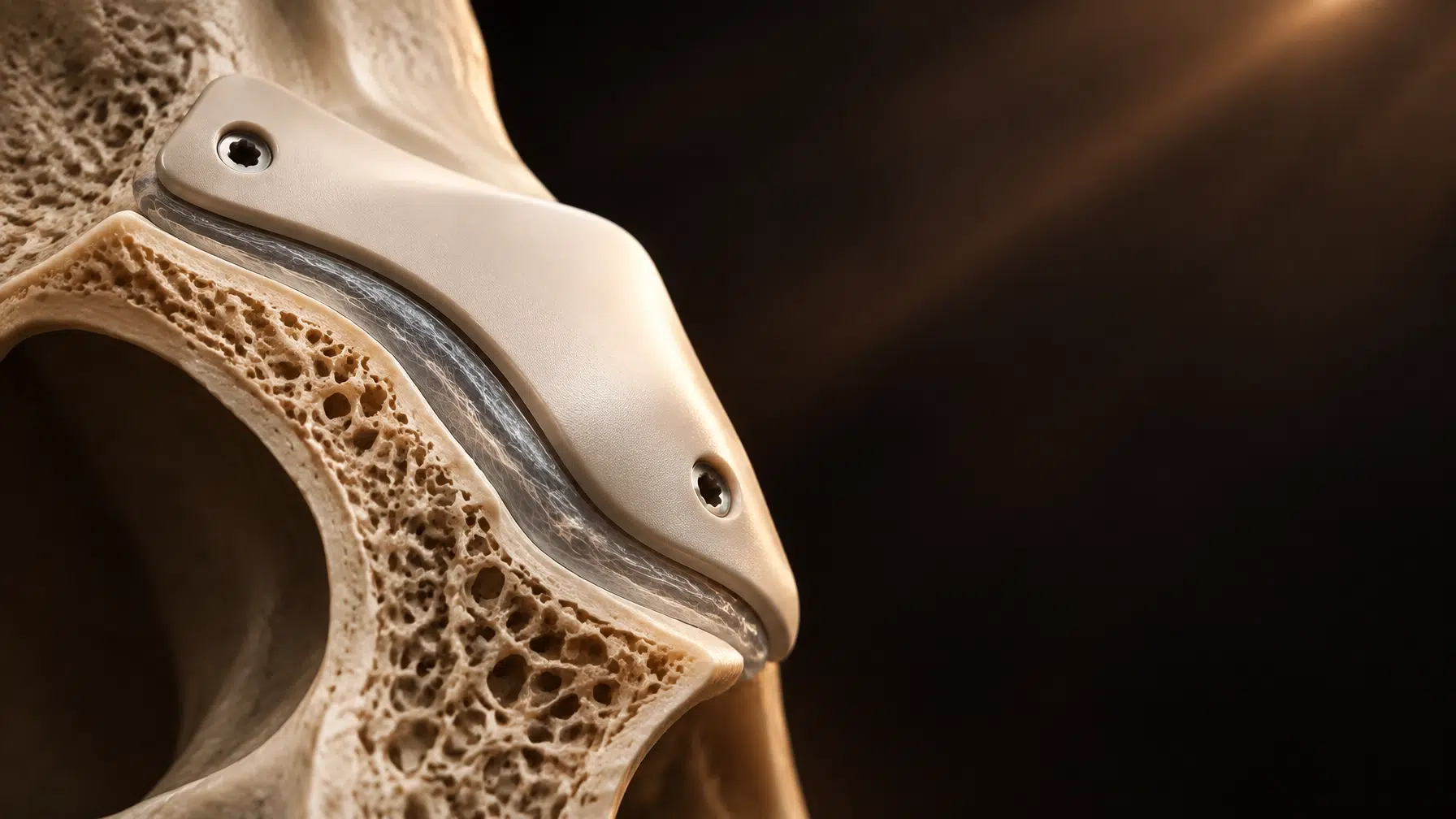
When an implant is relatively bio-inert, the surrounding tissue may respond by forming a fibrous capsule around it.
A capsule is a boundary. It separates the implant from the surrounding biological environment.
That capsule is not integration. It is defensive isolation.
The language matters because a fibrous layer can look biologically quiet while still creating an interface with important mechanical limitations. The absence of a dramatic acute reaction does not mean that the implant and bone are participating in a connected load-bearing system.
A fibrous capsule may function as:
- A separation layer between the implant and bone.
- A potential sliding plane under repeated force.
- A biological barrier that limits direct bone contact.
- A mechanically distinct interface between two structures that respond differently to load.
This does not mean that standard PEEK is inherently unsuitable for every application. It means that the material’s biological tolerance and its interface mechanics must be considered as separate questions.
Why is the interface not static?
The implant-bone interface is exposed to a changing mechanical environment.
In the facial skeleton, that environment can include:
- Cyclic chewing loads.
- Repeated muscle activity.
- Speech and jaw movement.
- Repetitive micro-impacts.
- Changes in soft-tissue tension.
- Adaptive bone remodeling.
- Variations in fixation, geometry, and local anatomy.
The interface is therefore not evaluated once and then left unchanged. It is continuously exposed to force.
A thin fibrous layer may respond differently from bone. The implant may also have different stiffness, surface characteristics, and frictional behavior from the tissue around it. These differences can influence how force is transmitted and how small movements develop at the interface.
The scientific literature on PEEK and implant interfaces is heterogeneous. Outcomes depend on factors such as surface design, fixation, geometry, loading, anatomy, and the intended clinical application. Reviews of PEEK in bone-related applications describe the importance of fibrous tissue formation, micromotion, surface characteristics, and load transfer in determining interface behavior. Review of PEEK in bone tissue engineering and orthopedic surgery

What can a separated interface do under load?
When the implant-bone interface does not provide a connected path for physiological load transmission, several mechanical concerns may arise.
These concerns include:
- Suboptimal load distribution: Forces may concentrate in particular regions rather than being shared across the intended contact area.
- Relative micro-displacement: Small positional changes may occur when the patient chews, speaks, or moves the jaw.
- Localized mechanical stress: Areas of bone may experience force patterns that differ from the surrounding biological structure.
- Progressive mechanical erosion: Sustained pressure and friction may contribute to localized loss of contacting bone in some circumstances.
The important insight is that micromovement is not the entire problem.
Micromovement can be a symptom of a deeper interface issue: the absence of a structural connection designed to transmit load in a controlled, physiologically compatible way.
That is why evaluating a material only through cytotoxicity or acute inflammatory testing cannot answer the full mechanical question. Static cell testing does not reproduce the repeated forces, geometry, fixation, and loading conditions experienced by a facial implant.
Is bone resorption the same as mechanical erosion?
No. These terms describe different processes.
Bone resorption is part of normal skeletal adaptation. Bone continuously responds to changes in loading, strain, and biological signals. In a healthy system, remodeling can help maintain structural balance.
Mechanical erosion describes a more concerning pattern of localized bone loss associated with sustained pressure, friction, stress concentration, or repetitive mechanical damage at an interface.
The distinction is important:
| Adaptive bone resorption | Mechanical erosion |
|---|---|
| A normal remodeling response | A pathological mechanical response |
| Helps bone adapt to changing loads | May reflect sustained pressure or friction |
| Can participate in structural maintenance | Can progressively weaken contacting bone |
| Depends on the broader biological environment | Requires evaluation of interface mechanics and tissue response |
The presence of bone remodeling does not automatically prove implant failure. Nor does a fibrous interface automatically predict a specific outcome for an individual patient.
The treating surgeon must evaluate the patient’s anatomy, implant position, fixation, loading environment, symptoms, imaging, and clinical history before drawing conclusions.
What is the engineering question behind PEEK?
PEEK is the material. Bioactive PEEK is DMI’s engineered approach to that material.
PEEK was the starting point. Bioactive PEEK is where we took it further.
The engineering question is not simply whether PEEK can be tolerated. It is whether the implant is designed around the mechanical and biological conditions of its intended application.
That includes consideration of:
- Fit: How closely the implant conforms to the patient-specific anatomy.
- Stability: How the geometry and fixation strategy are intended to control movement.
- Load distribution: How the implant is designed to manage force across the contact region.
- Surface and interface design: How the implant’s engineered characteristics are intended to address the behavior of the surrounding environment.
- Manufacturing control: How the final device is produced according to the approved design.
- Surgical collaboration: How the treating surgeon evaluates the design within the clinical workflow.
DMI does not manufacture standard PEEK implants. DMI exclusively uses DMI Bioactive PEEK for its implants and engineers each patient-specific solution around the relevant anatomy, surgical objectives, design requirements, and manufacturing process.
That statement is about design intent. It is not a promise that a particular implant will integrate, produce a specific biological response, or eliminate complications.

Why does patient-specific design matter?
The interface cannot be separated from the implant’s geometry.
An implant that is poorly matched to the underlying anatomy may concentrate force differently from an implant designed around accurate patient-specific data. Position, contour, thickness, fixation, contact area, and surrounding structures all influence the engineering problem.
This is why DMI begins with patient-specific information and collaborative planning rather than treating a standard shape as the complete solution.
The process may include:
- Imaging review: Appropriate CBCT and DICOM information provides the anatomical foundation for planning.
- Three-dimensional modeling: The anatomy is mapped so the implant concept can be developed around the individual structure.
- Design refinement: DMI and the surgical team review the design and refine relevant features.
- Engineering cross-check: Fit, stability, fixation, and load distribution are considered within the applicable workflow.
- Surgeon review: The treating surgeon evaluates clinical appropriateness and determines whether the proposed approach fits the patient’s treatment plan.
- Manufacturing: The implant is produced after the required design and clinical approvals are complete.
The objective is not to claim a guaranteed biological result. The objective is to engineer a more deliberate, patient-specific device around the conditions that matter.
What is DMI’s position?
The hidden limitation of a conventional PEEK implant is not necessarily its basic chemical stability or its ability to pass a biocompatibility screen.
The deeper issue is the gap between being tolerated and being engineered for a meaningful implant-tissue interface.
A fibrous capsule may isolate an implant. A mechanically separated interface may experience relative movement. Repeated loading may expose weaknesses in fit, fixation, contact, or load distribution.
DMI’s position is that these considerations deserve attention during design rather than being treated as secondary details.
The implant is not the finish line. The interface is part of the engineering problem.
DMI Bioactive PEEK is designed around that broader problem. The approach is engineered with the objective of addressing fit, stability, fixation, interface behavior, and load distribution through patient-specific design and collaboration with the treating surgical team.
Learn more about the material and process
You can explore DMI’s materials approach, review facial implant questions and answers, or learn more about DMI Bioactive PEEK.
DMI collaborates with multiple surgical teams. You are free to choose any qualified surgeon, and information about a surgeon who works with DMI is provided for information only, not as a recommendation or referral.
Where to go from here
You now know what biocompatibility testing does — and what it doesn’t. You know that the interface, not just the material, is the engineering problem.
The next step is not choosing a material off a webpage. It is a conversation.
If you are a patient: begin with a conversation with the DMI team. We will walk you through the process — imaging requirements, the digital design workflow, and how a patient-specific implant is engineered around your anatomy — and help coordinate the clinical pathway with a qualified surgeon.
Educational note
This article is for educational purposes and is not medical advice. It does not determine candidacy or clinical appropriateness. A qualified treating surgeon must evaluate your individual anatomy, medical history, treatment goals, and available options before making clinical decisions.