
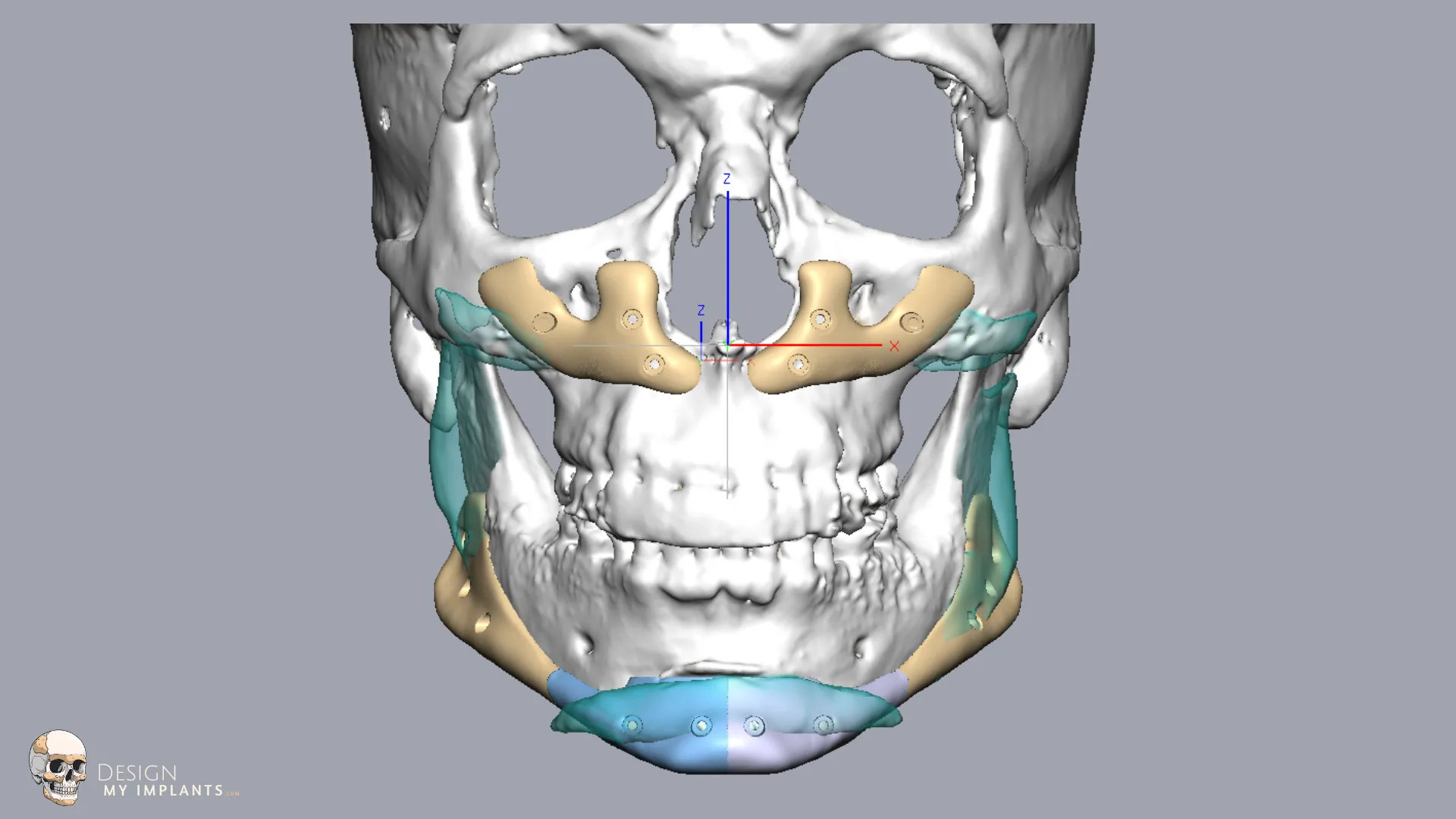
New patient-specific jaw, paranasal, and chin implant design over the patient’s skull, frontal view.
The Oddest Aspect of Our Business
One of the most unexpected aspects of our business is how many healthcare professionals choose Design My Implants for their own facial implant procedures.
Dentists. Nurses. Psychologists. Other healthcare professionals who spend their careers helping people navigate their health and appearance.
We have always known that the healthcare community can be surprisingly small. Still, it never ceases to amaze us how often a professional connection turns into a personal journey.
Today's case involves a good friend of ours who happens to be a dentist.
We wish we could tell you that everything went exactly as planned. It didn't.
But at Design My Implants, we believe there is value in discussing difficult cases honestly. Not every case unfolds as expected, and some of the most important lessons come from the situations that challenge even experienced professionals.
This case reminded us of something fundamental about custom facial implants: the anatomy we see on a scan does not always tell the entire story.
Seven Years With Silicone Facial Implants
Seven years before this revision procedure, our patient had received silicone facial implants.
When we evaluated his anatomy for the new design, the imaging revealed significant changes in the underlying bone. There was visible bone erosion in the jaw and chin regions, with changes also apparent in part of the cheek area.
The existing implants were visible on the CBCT scan, allowing us to assess their position and begin planning patient-specific replacements around the altered anatomy.

Pre-operative lateral skull views showing bone erosion.
This is one of the important distinctions between custom facial implants and standard, premanufactured implants.
When the underlying anatomy has changed, a replacement cannot simply be selected from a catalog and expected to fit. The design must account for the patient's current anatomy and the objectives established with the treating surgeon.
Our engineering team approached the case with that principle in mind.
We knew the new custom jaw implants and associated facial implants would have to accommodate the changes we could see.
What we did not anticipate was what we could not see clearly enough.
The Unexpected Complication: Permanent Fillers and Calcified Tissue
Over the seven years following his original implant surgery, our patient had also received facial fillers.
As the volume he had previously achieved diminished, he underwent additional injections using permanent filler material.
By the time we were planning his revision, some of that material had become hardened and calcified, creating an unexpected challenge.
The CBCT images did not fully reveal the nature or extent of the material surrounding the existing implants.
From the available imaging, portions of the hardened material appeared similar to the surrounding bone. Its actual composition and relationship to the implants were not fully appreciated before surgery.
That distinction became critical.
What the Surgical Team Discovered
During surgery, the treating surgeon encountered anatomy that differed substantially from what the preoperative images had suggested.
The existing implants were not simply sitting along the outer surface of the bone as anticipated. They had become surrounded and effectively buried within hardened material associated with the previous filler injections.
What had initially appeared to be bone on the CBCT did not accurately represent the composition of the entire mass.
The calcified material had formed around the implants, making their removal considerably more difficult than expected.
Removing the old implants and addressing the surrounding hardened material consumed a substantial portion of the surgical time.
More importantly, the remaining anatomy no longer accommodated the planned replacement jaw implants as designed.

Pre-operative skull with prior implant volumes highlighted in teal.
The problem was no longer just designing an implant to fit the bone. It was understanding what the surrounding tissue actually consisted of.
Despite the planning performed beforehand, the unexpected findings made it impractical to replace the jaw implants during that procedure.
The surgical team was able to replace the chin and cheek implants. The jaw region, however, presented a different challenge.
The surgeon prepared the area with the possibility of a future revision in mind, but uncertainty remains about whether the residual hardened material can be adequately identified and addressed in another intervention.
It was not the outcome any of us had hoped for.
And it reinforced a lesson that extends far beyond this particular patient.
Why Custom Facial Implant Design Has Limits
Custom facial implants offer an important advantage: their geometry can be engineered around patient-specific anatomy rather than relying exclusively on a pre-existing implant shape.
That advantage becomes particularly valuable when a patient has undergone previous facial implant surgery, experienced changes in bone structure, or requires revision planning.
But customization has limits.
A three-dimensional design is only as useful as the anatomical information available to support it. Imaging provides valuable information about structure, but it does not always establish the precise composition of every tissue or material encountered during surgery.
Previous implants, fillers, scar tissue, calcification, and other anatomical changes can complicate revision procedures.
This case demonstrated three important principles.
1. Previous facial procedures matter
When planning custom jaw implants, custom chin implants, or custom cheek implants, the patient's procedural history is an important part of the planning discussion.
Previous implants may have altered the underlying bone. Previous filler treatments may have left material in the surrounding tissues. Multiple procedures can create an anatomy that differs significantly from what would be expected in a first-time implant case.
The more complete the available history, the better positioned the treating team is to evaluate potential challenges.
Patients considering facial implant revision surgery should disclose previous implant procedures, filler injections, and other treatments—even those performed many years earlier.
2. Imaging must be interpreted in context
CBCT imaging provides valuable three-dimensional information about facial skeletal anatomy and supports patient-specific engineering.
However, imaging has limitations.
In this case, the hardened material surrounding the existing implants was not fully characterized before surgery. Its appearance on the scan did not adequately communicate the challenge it would create during removal and replacement.
This is an important distinction: a scan can provide an accurate representation of visible structures without necessarily identifying the exact composition of every material within them.
When a patient has a complex history of previous facial procedures, the treating surgeon must evaluate whether additional investigation or a modified surgical plan is warranted.
Digital engineering supports this process, but it cannot independently resolve every uncertainty about the patient's anatomy.
3. A custom design cannot eliminate every surgical uncertainty
A custom implant can be engineered around the anatomy identified during planning.
It cannot guarantee that all intraoperative findings will match the preoperative model.
That is especially important in revision surgery, where previous procedures may have altered the bone and surrounding tissues in ways that are difficult to characterize completely.
At Design My Implants, our responsibility is to engineer patient-specific implants within the established surgical workflow. The treating surgeon remains responsible for clinical assessment, surgical decisions, and determining how to respond when actual findings differ from expectations.
Good engineering matters. So does recognizing what engineering cannot predict.
What This Case Teaches Us About Permanent Fillers
This case also highlights the importance of understanding the long-term implications of permanent facial filler materials.
Unlike temporary fillers that are intended to diminish over time, permanent fillers may remain in the tissues for years. Depending on the material and the individual circumstances, complications can include persistent nodules, inflammation, migration, and other tissue changes. Some materials may also undergo calcification.
The experience of this patient should not be interpreted as proof that every permanent filler will calcify, damage bone, or cause complications. Different materials behave differently, and individual outcomes vary.
However, the case illustrates why patients should carefully discuss the properties, risks, and long-term implications of any permanent facial injectable with a qualified medical professional.
This is particularly important for people who may consider facial implant surgery in the future.
A filler treatment and a custom facial implant are different interventions, but their histories can intersect when a patient later requires surgery.
If you have received permanent fillers and are considering custom jaw implants, chin implants, cheek implants, or facial implant revision surgery, disclose that history during your consultation. Do not assume that an old treatment is irrelevant simply because it was performed years ago.
The appropriate evaluation depends on the material used, its location, your current anatomy, and the judgment of your treating surgeon.
Why Revision Cases Require a Different Level of Planning
A first-time facial implant procedure and a complex revision are not necessarily comparable.
In a primary case, the engineering team works with the patient's existing anatomy to develop a proposed design.
In a revision case, the starting point may be an altered anatomical environment shaped by previous implants, changes in bone structure, scar tissue, or residual injected materials.
That can change the entire planning process.
For patients considering custom facial implants after previous surgery, the discussion should include:
- A complete history of previous implants, injections, and facial procedures.
- Review of available imaging and the changes visible in the underlying bone.
- Evaluation by the treating surgeon of potential complications and anatomical uncertainties.
- Clear communication between the surgeon and engineering team about the intended design.
- An understanding that the final surgical approach may need to change if unexpected findings are encountered.

Occlusal and basal views of the jaw implant design.
No amount of digital precision can eliminate every uncertainty. But recognizing potential limitations before surgery is an important part of responsible planning.
The Design My Implants Philosophy: The Anatomy Comes First
At Design My Implants, we believe that patient-specific engineering must begin with the individual—not with a predetermined implant shape.
Our work focuses on engineering custom facial implants around patient-specific anatomy and the objectives established within the surgical workflow.
We work with facial implant designs involving the chin, jaw body, jaw angles, cheeks, and other facial regions, depending on the approved plan.
DMI exclusively engineers facial implants using DMI Bioactive PEEK, our engineered approach to PEEK and its surface.
But the material and the design are only part of the larger picture.
The patient's anatomy matters. Their procedural history matters. The information available before surgery matters. And the treating surgeon's clinical judgment matters.
This case was difficult precisely because some of the most important information became apparent only during surgery.
We could engineer around the anatomy we understood, but the unexpected hardened material created a challenge that the original design could not overcome.
We share this experience because responsible innovation requires more than celebrating successful outcomes. It also requires examining difficult cases, acknowledging uncertainty, and learning where planning must account for what cannot yet be fully understood.
Frequently Asked Questions About Custom Facial Implants and Revision Surgery
Can custom jaw implants be designed after previous silicone implants?
Potentially, yes. Custom jaw implants can be engineered around altered anatomy, including certain changes associated with previous implant procedures. However, the feasibility of revision depends on the patient's current anatomy, the condition of the surrounding tissues, and the treating surgeon's assessment.
Can permanent fillers complicate facial implant surgery?
Yes. Depending on the material and the individual case, permanent fillers may persist for years and can be associated with complications such as inflammation, nodules, migration, or calcification. Their presence may complicate the evaluation and surgical management of a patient seeking facial implants.
Can a CBCT scan identify permanent fillers or calcified tissue?
CBCT provides valuable three-dimensional information, particularly about facial skeletal anatomy. However, it does not always establish the precise composition of every material or tissue encountered during surgery. Additional evaluation may be necessary depending on the patient's history and the surgeon's findings.
Can custom facial implants correct bone erosion caused by previous implants?
Custom implants may be designed around certain anatomical changes, but the suitability of a proposed reconstruction depends on the extent of the bone changes, the condition of the surrounding tissues, and the clinical treatment plan. Custom engineering alone cannot guarantee that reconstruction will be feasible.
Does Design My Implants determine whether a patient is suitable for revision surgery?
No. DMI provides engineering, design, and manufacturing coordination within the appropriate surgical workflow. The treating surgeon evaluates the patient, determines candidacy, and makes clinical decisions about whether revision surgery is appropriate.
The Most Important Lesson
We began this case expecting to engineer custom facial implants around anatomy that had changed over seven years.
We did not anticipate the extent to which hardened material associated with previous permanent filler injections would complicate the procedure.
The experience was difficult for the patient, the surgeon, and everyone involved in the planning process.
But it reinforced a principle we take seriously at Design My Implants:
Custom does not mean predictable in every circumstance. It means the design is tailored to the individual anatomy we can evaluate—and that the limitations of that evaluation must be respected.
If you are considering custom jaw implants, custom chin implants, custom cheek implants, or facial implant revision surgery, your previous procedures deserve careful consideration as part of the planning process.
At Design My Implants, we can help explain the patient-specific engineering process, the role of three-dimensional imaging, and how implant design fits into a broader surgical workflow.
Your history matters. Your anatomy matters. And the right plan begins with understanding both.
Design My Implants — Where Beauty is Bone Deep.
Sources and Further Reading
Editorial note: This article describes an individual case and is intended for educational purposes. It does not establish that the same complications will occur in other patients or replace an individualized medical evaluation.