
One of the most important things surgeons and patients should understand about facial implants is that the implant itself is only part of the equation.
The material matters. The design matters. And perhaps just as importantly, the positioning matters.
This beautiful young woman came to us after receiving a facial implant made from material that, in our assessment of her case, was not appropriate for the intended application. The resulting bone changes were clearly visible on her imaging.
The implant had been in place for only two years.
Two years.
Now consider what continued bone resorption could mean if the underlying problem were left unaddressed for another two years.
Bone resorption is not something patients should dismiss as an insignificant finding. Changes in the underlying bone can affect implant support, surrounding anatomy, and the complexity of future revision procedures.
This is precisely why we believe surgeons and patients should pay close attention to implant material, geometry, and anatomical positioning before surgery.
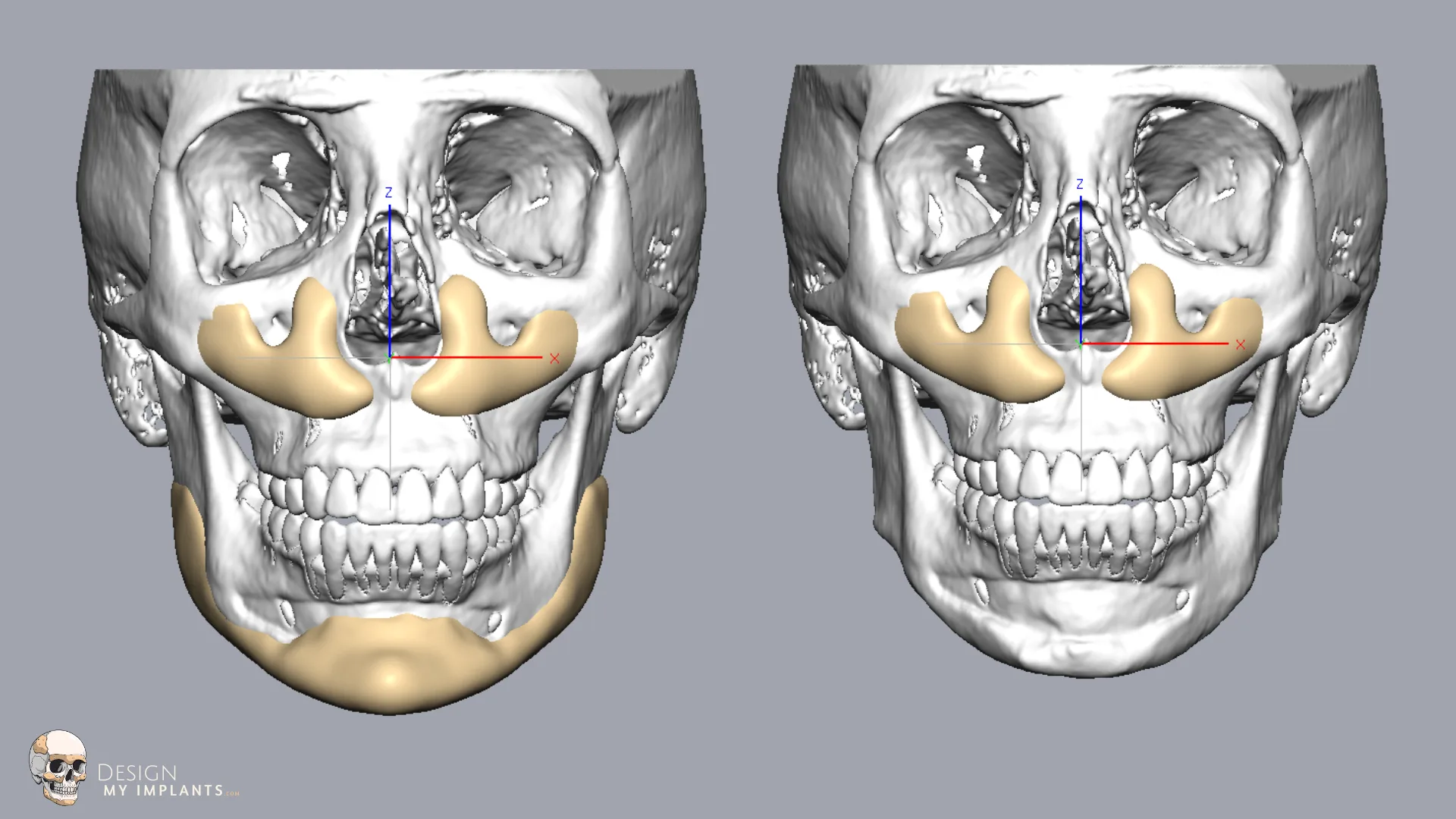
Pre-operative skull (left) compared with patient-specific implant design overlay (right), including paranasal, jaw and chin implants, planned on the patient’s CBCT imaging.
When Implant Positioning Becomes a Problem
Material was not the only concern in this case.
The previous implant had also been positioned poorly, directly over the region of the mental foramen and its associated nerve.
The mental nerve provides sensation to the lower lip and chin. Its location is an important anatomical consideration when planning chin and lower-face implants.
In this patient's case, the implant's positioning was associated with a significant loss of sensation.
She had experienced a tremendous reduction in sensitivity, an issue that affected more than just the appearance of her lower face.
This illustrates an important principle: a facial implant must be designed and positioned with respect for the underlying anatomy, including important nerves and surrounding structures.
A beautiful aesthetic objective should never overshadow anatomical considerations.

Pre-operative bone scans, frontal and inferior oblique views of the mandible and mental region.
Our Approach: A Classy, Timeless Result
When we began working with this patient, her objective was clear.
She wanted a classy, timeless aesthetic.
Not an exaggerated transformation. Not an oversized chin or an artificially sculpted face.
She wanted refinement.
And that became the guiding principle of the design.
At Design My Implants, we believe that custom facial implants should complement the individual rather than impose a standardized aesthetic.
Our engineering approach considers the patient's existing anatomy, the intended contours, and the objectives established with the treating surgeon.
For this case, the goal was to create a result that respected her natural beauty while addressing the structural concerns that brought her to us.
She was already a beautiful woman.
But the transformation was extraordinary. Astonishing almost doesn't do it justice.

Implant design overlay over the pre-operative skull and soft tissue envelope, frontal view.
The objective was never to make her look like someone else. It was to create a more harmonious result that reflected the aesthetic direction she wanted.
Why We Engineer Facial Implants Using DMI Bioactive PEEK
At Design My Implants, we exclusively engineer facial implants using DMI Bioactive PEEK.
PEEK is a high-performance polymer used in medical applications. DMI Bioactive PEEK represents our engineered approach to the material and its surface.
We believe implant engineering should go beyond selecting a material and creating a shape.
It should consider the relationship between the implant, the patient's anatomy, the intended soft-tissue contours, and the surgical objectives.
Our patient-specific engineering process allows custom chin implants, jaw implants, cheek implants, and other facial implants to be developed around individual anatomical structures rather than relying exclusively on standardized implant shapes.
This is especially important in revision cases, where previous implants may have altered the underlying bone or surrounding anatomy.
Material selection alone does not guarantee a clinical outcome. Nor does a custom design eliminate every potential complication. The treating surgeon must evaluate the patient's anatomy and determine the appropriate surgical approach.
But we believe these considerations should be part of every serious discussion about facial implant design.
The Takeaway for Surgeons and Patients
This case reinforces three important lessons:
- Bone resorption deserves attention. Changes in the underlying bone should be evaluated rather than dismissed, particularly when they are associated with an existing implant.
- Material selection matters. The properties and suitability of an implant material should be considered in relation to its intended application.
- Anatomical positioning is critical. Important structures, including the mental nerve, must be considered during implant planning and placement.
For patients, the lesson is equally important: don't evaluate a facial implant solely by its immediate aesthetic result. Ask about the material, the design, the anatomical considerations, and the long-term treatment plan.
For surgeons, patient-specific engineering offers an opportunity to approach facial reconstruction and augmentation with greater attention to individual anatomy.
At Design My Implants, these principles are central to our approach.
We don't believe in making every face look the same. We believe in engineering around what makes each face unique.
The Beauty Is in the Details
This patient came to us wanting a classy, timeless aesthetic. She left with a transformation that exceeded our expectations.
But beyond the aesthetic result, her case is an important reminder of why facial implant engineering deserves serious consideration.
The material matters.
The positioning matters.
The anatomy matters.
And the individual always comes first.
Design My Implants — Where Beauty is Bone Deep.