
It Wasn't a Volume Problem. It Was a Fit Problem.
This young patient came to Design My Implants through her orthognathic surgeon.
Her objective was straightforward: subtle, precise correction of chin asymmetry following orthognathic surgery.
But straightforward does not always mean simple.
When a patient has a slim build, the soft tissue envelope matters as much as the bone beneath it. There is less room for unnecessary volume, and even small differences in implant geometry can influence the final facial contour.
Her asymmetry was never simply a matter of needing more projection or added volume.
The challenge was creating a patient-specific symmetry corrective implant that addressed the anatomical deficiency without adding bulk where her anatomy did not need it.
An off-the-shelf implant would have introduced a predetermined geometry rather than one developed around her specific skeletal contours.
We took a different approach.
Engineering Symmetry, Not Augmentation
The design process began with her imaging.
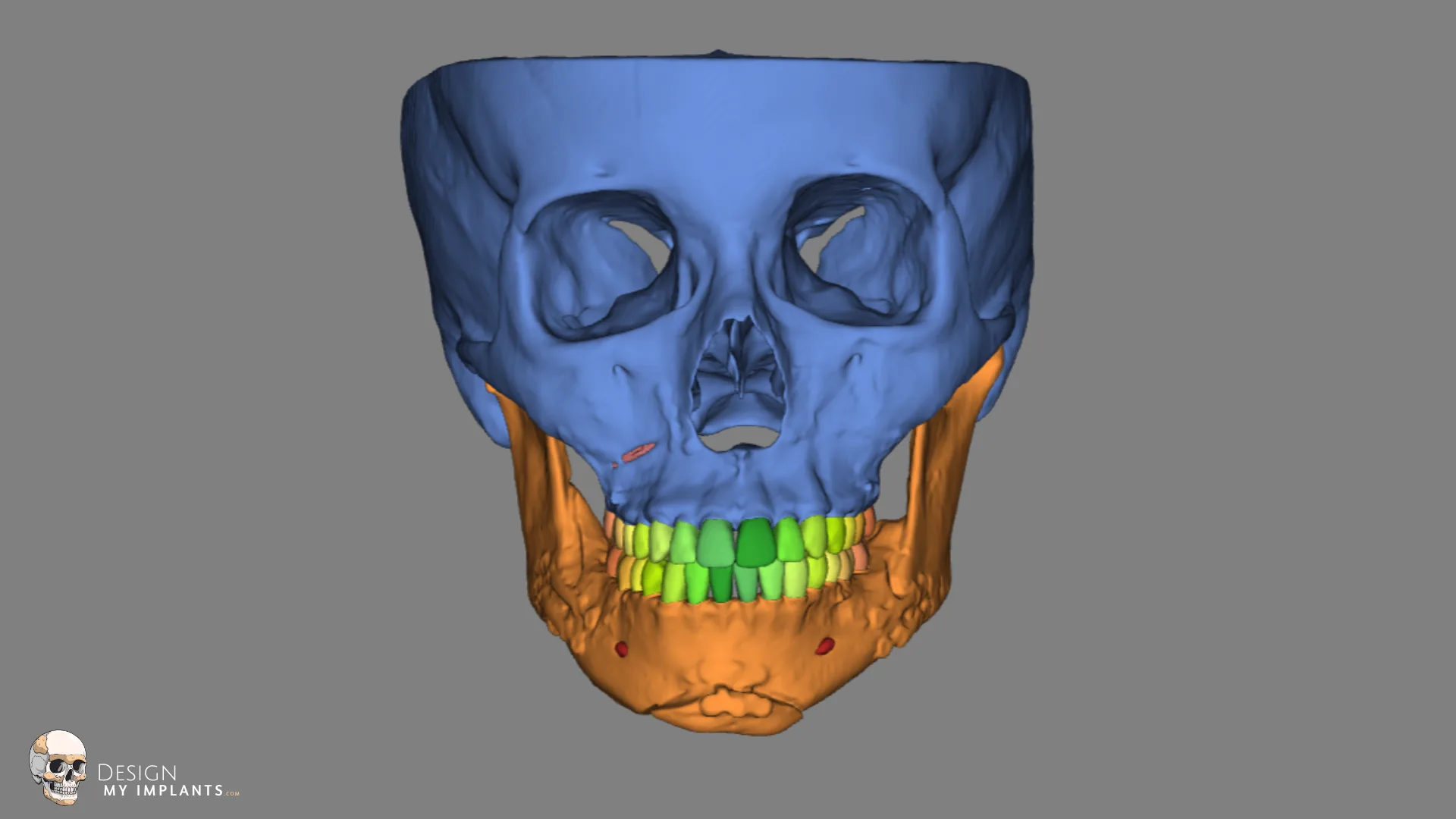
Our engineering team reconstructed the maxilla and mandible in three dimensions, establishing an anatomical reference for the design. We evaluated the existing skeletal contours and considered the soft tissue envelope in relation to the underlying bone.
This allowed us to identify the specific area requiring correction.
Rather than designing a conventional chin or jaw augmentation implant, we developed a localized, patient-specific mandibular symmetry corrective implant.
Its geometry was engineered to follow the existing mandibular anatomy while addressing the specific contour deficiency.
The objective was precise:
Correct the asymmetry. Fill the deficit. Avoid unnecessary augmentation.
The patient’s facial skeleton reconstructed in three dimensions to establish the anatomical foundation for patient-specific implant engineering.

The symmetry corrective implant positioned in relation to the patient’s existing mandibular anatomy.

An oblique view illustrating the customized implant geometry and fixation features.
Why the Soft Tissue Envelope Matters
Facial implant engineering cannot stop at the bone.
The soft tissue envelope influences how the underlying implant geometry relates to the visible facial contour.
This consideration becomes especially important in patients with a slim build, where unnecessary projection or volume may become more noticeable.
For this patient, the design had to respect two things simultaneously:
- The underlying skeletal anatomy and the precise location of the asymmetry.
- The available soft tissue envelope and the contour it needed to accommodate.
The goal was never to create a larger chin or a more prominent jaw.
It was to create a more harmonious contour by correcting the specific asymmetry without overcorrecting the area.
This is one of the fundamental differences between patient-specific engineering and simply selecting an implant based on its general shape.
From Three-Dimensional Imaging to Patient-Specific Design
Our engineering process combines anatomical reconstruction, digital design, and collaborative refinement.
For this case, the workflow involved:
- Three-dimensional reconstruction: The maxilla and mandible were reconstructed from the patient's imaging.
- Anatomical evaluation: The location and geometry of the asymmetry were evaluated in relation to the surrounding skeletal structures.
- Soft tissue considerations: The available soft tissue envelope was considered alongside the underlying bone.
- Patient-specific geometry: A custom symmetry corrective implant was engineered to address the identified deficit without unnecessary augmentation.
- Collaborative design review: The design was refined through collaboration within the established surgical workflow.
- Surgeon-led approval: The treating surgeon retained responsibility for all clinical decisions.
The result is an implant design developed around the individual rather than a standardized shape.
Why DMI Bioactive PEEK?
At Design My Implants, we exclusively engineer facial implants using DMI Bioactive PEEK.
PEEK is a high-performance polymer used in medical applications. DMI Bioactive PEEK represents our engineered approach to this material and its surface.
We believe that facial implant engineering involves more than choosing a material or creating an attractive shape.
It requires considering how the implant geometry relates to the patient's anatomy, the intended soft tissue contours, and the objectives established with the treating surgeon.
Our approach combines:
- Patient-specific three-dimensional engineering.
- Anatomically adapted implant geometry.
- Consideration of the surrounding soft tissue envelope.
- DMI Bioactive PEEK material and surface engineering.
- Collaborative refinement within a surgeon-led workflow.
Whether the objective involves custom mandibular implants, chin implants, cheek implants, or other facial implant designs, the starting point remains the same: the individual's anatomy.
The Result of Precision Is Not Always Augmentation
Some transformations are about making a feature more prominent.
Others are about correcting what is out of place.
This case belonged to the second category.
The objective was never to make her chin bigger. It was to address a specific asymmetry while respecting her natural proportions and soft tissue.
The engineering process was built around that distinction.
Because sometimes the best implant is not the one that adds the most.
It is the one that fits exactly where it needs to.
The result of the planning is not augmentation. It is resolution.
Frequently Asked Questions
What is a facial symmetry corrective implant?
A facial symmetry corrective implant is a patient-specific implant engineered to address a localized anatomical contour deficiency or asymmetry. Its geometry is designed around the specific area requiring correction rather than primarily to add generalized facial volume.
Can custom implants correct facial asymmetry after orthognathic surgery?
Custom facial implants may be considered when residual asymmetry remains after orthognathic surgery. Three-dimensional imaging can provide the anatomical foundation for developing an implant around the patient's current skeletal contours. The treating surgeon determines whether this approach is appropriate.
Why is the soft tissue envelope important when designing facial implants?
The soft tissue envelope influences how implant geometry relates to the visible facial contour. Considering both the bone and surrounding soft tissue helps inform a more individualized design.
Are custom mandibular implants different from standard implants?
Custom mandibular implants are engineered around patient-specific anatomy rather than selected exclusively from predetermined shapes. This allows the design to address localized anatomical requirements and specific contour deficiencies.
What material does Design My Implants use?
DMI exclusively engineers facial implants using DMI Bioactive PEEK, its engineered approach to PEEK and its surface.
Does DMI perform the surgery?
No. Design My Implants provides patient-specific engineering, implant design, and manufacturing coordination within a surgeon-led workflow. The treating surgeon makes all clinical decisions and performs the surgical procedure.
Precision Is Bone Deep.
At Design My Implants, we believe that great facial implant engineering begins with understanding the individual.
Not every patient needs more volume. Not every asymmetry requires augmentation. And not every face should be approached with the same geometry.
Sometimes the most sophisticated solution is also the most subtle.
We engineer around anatomy, not templates.
Your anatomy is unique. Your implant should be, too.
Design My Implants — Where Beauty is Bone Deep.
This article describes an individual engineering case for educational and informational purposes. It does not guarantee a particular surgical or aesthetic outcome. Treatment decisions and clinical suitability are determined by the treating surgeon.